Balance: Understand Your Batter Ratio
When an ambitious home baker pulls a tray of muffins from the oven and finds flat, greasy caps or dry, bready interiors, the temptation is to blame the oven or discard the recipe entirely. In practice, almost every structural defect originates at the scale. By translating arbitrary cup measurements into baker's percentages—where total flour weight always equals 100%—you gain the ability to diagnose and re-engineer any muffin formula before a single tin is greased.
1. The Structural Backbone: Flour Protein and Starch
Standard grocery all-purpose flours vary widely by milling region. In North America, brands such as King Arthur Unbleached All-Purpose sit at 11.7% protein, whereas Gold Medal hovers near 10.5%, and southern soft-wheat flours like White Lily drop to 8.5%. In the United Kingdom, standard plain flour averages 9.5% to 10.5% protein. That 3% spread represents the boundary between a chewy bagel-like crumb and a delicate pastry crumb.
When water meets wheat flour, gliadin and glutenin proteins bond into a viscoelastic network, while damaged starch granules absorb up to 200% of their weight in water when heated past 60°C (140°F). For an elevated, bakery-style crown that still bites cleanly, target a composite protein level of 9.8% to 10.4%. You can achieve this reproducibly by blending 75% standard all-purpose flour (11.5% protein) with 25% unbleached pastry or cake flour (8.0% protein).
2. Hydration Dynamics: Free Water vs. Bound Water
Beginners frequently swap whole milk, buttermilk, Greek yogurt, and plant milks one-for-one by volume. However, hydration is governed not just by water content—whole milk is 88% water while full-fat sour cream is roughly 74% water—but also by how dairy proteins and lactic acid interact with starch viscosity.
Cultured dairy products (buttermilk at pH 4.5, skyr, or crème fraîche) carry bound casein micelles that thicken the unbaked batter without adding extra flour. A high-viscosity batter traps carbon dioxide micro-bubbles produced by baking powder during the initial stage in the oven, preventing gas from escaping prematurely through the top surface.
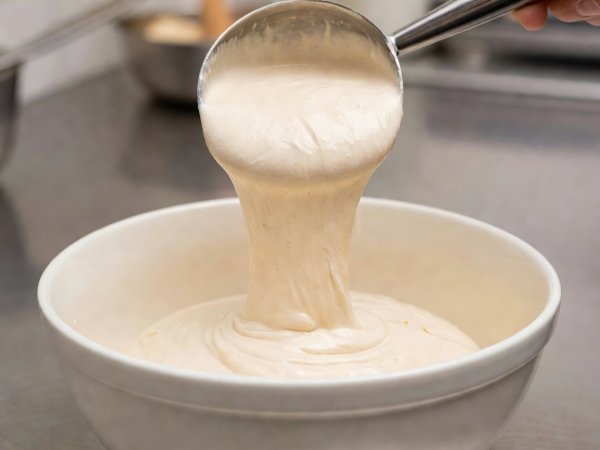
The Scoop-Drop Viscosity Cue
A properly balancedbakery-style batter (80% hydration using cultured dairy) should not pour like pancake batter. When lifted on a spatula, it should cling for two full seconds before breaking off in a heavy, V-shaped tongue that leaves distinct ridges on the bowl surface.
3. Reference Formulation Matrix
Compare the three primary architectural styles of muffins below. Every percentage is expressed relative to 100% total flour weight (e.g., for 300g flour, 60% sugar equals 180g).
| Component | Classic Diner Style (Light & Crumbly) | High-Crown Bakery Style (Plush & Tall) | Whole-Grain Hearty (Bran / Khorasan) |
|---|---|---|---|
| Flour Blend | 100% All-Purpose (10.5% protein) | 75% AP + 25% Pastry Flour | 60% AP + 40% Sifted Whole Wheat |
| Total Sugar | 45% – 55% | 65% – 75% | 50% – 60% (incl. honey/molasses) |
| Fat / Lipid | 35% Melted Butter | 25% Butter + 25% Neutral Oil | 45% Olive or Brown Butter |
| Whole Eggs | 30% (approx. 1.5 eggs per 250g flour) | 40% (approx. 2 large eggs per 250g flour) | 35% |
| Dairy Hydration | 75% Whole Milk | 85% Full-Fat Sour Cream / Buttermilk | 95% Cultured Buttermilk (soaked 20m) |
| Leavening | 3.5% Double-Acting Baking Powder | 4.0% Baking Powder + 0.5% Baking Soda | 3.5% Baking Powder + 0.8% Baking Soda |
4. Balancing Chemical Leaveners and Acidity
Baking soda (sodium bicarbonate) requires an acidic partner to react immediately upon mixing and again when heated. One-quarter teaspoon (1.2g) of baking soda neutralizes the acid in roughly 120g (1/2 cup) of cultured buttermilk or yogurt. Double-acting baking powder (which combines sodium bicarbonate with monocalcium phosphate for cold nucleation and sodium aluminum sulfate or sodium acid pyrophosphate for heat-triggered expansion) handles the primary vertical lift.
What happens when you over-scale leavening? Bakers chasing taller crowns frequently double the baking powder. Instead of rising higher, the batter over-inflates before the starch-protein matrix coagulates at 82°C (180°F). The fragile cell walls rupture, gas vents into the oven chamber, and the center collapses into a dense, soapy-tasting crater. Keep total chemical leavening strictly between 3.5% and 4.5% of flour weight.